
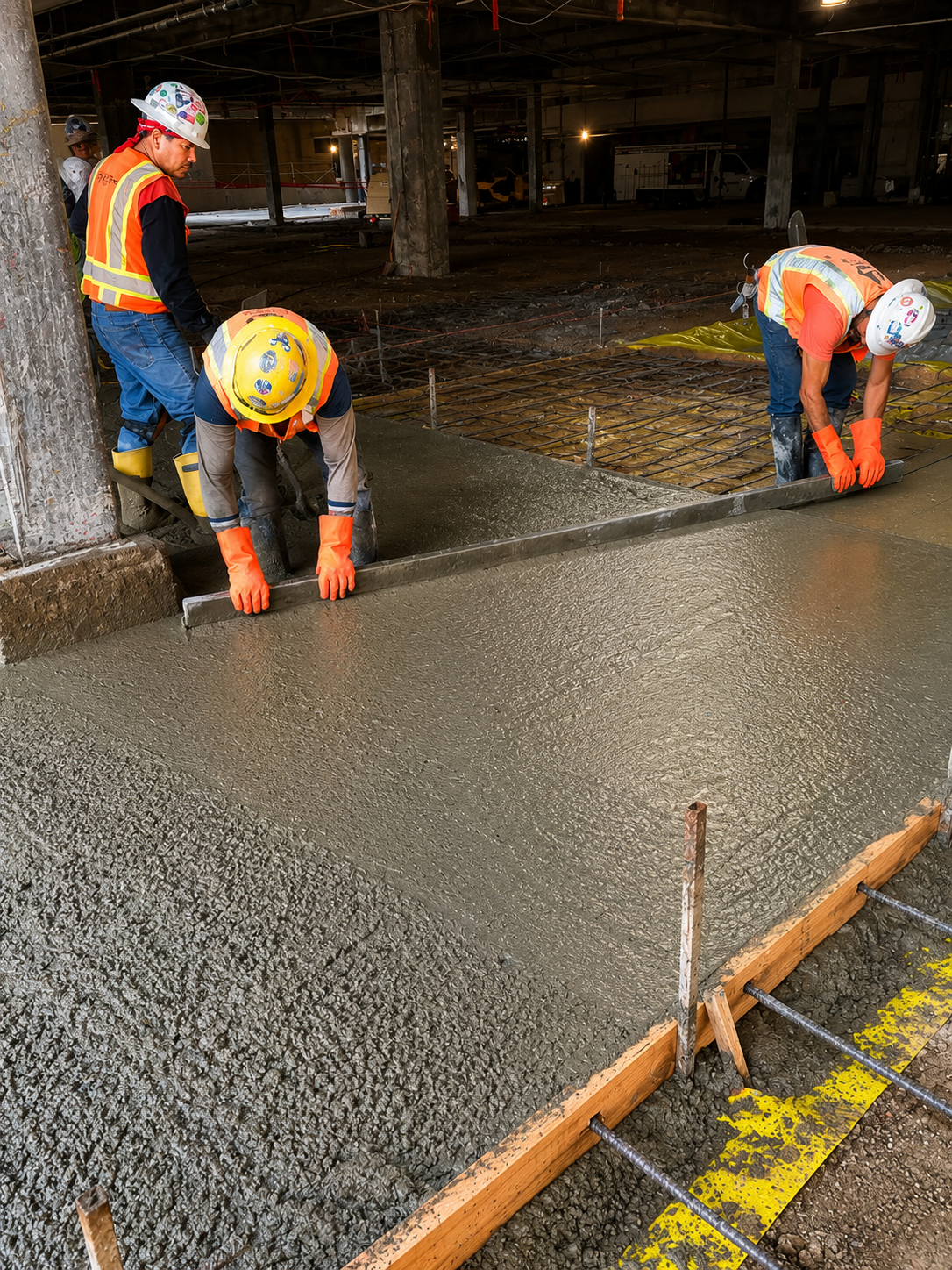
An addition is going up. A deck is being poured. An ADU is being permitted. None of it stands up without footings — and footings are the part nobody sees, the part everyone underestimates, and the part that has to be exactly right because everything above it depends on it.

Footings.
Reinforced footings for additions, decks, ADUs — the hidden work that holds everything else up.
Footings done late costs more than footings done right.
An undersized footing settles. A footing without rebar continuity at corners cracks. A footing poured on disturbed soil moves the first wet winter. The fix isn't fixing the footing — it's tearing out the deck, the addition, the ADU and starting over. The most expensive concrete you'll ever pay for is the concrete you're paying for twice.
We pour reinforced concrete footings for additions, decks, garden walls, ADUs, and detached structures across the Bay. Footings sized to the load, depth-set to the soil, rebar continuous at corners, anchor bolts placed during the pour to spec. CSLB #917675 (B · C-8 · C-36 — useful when ADU footings need rough-in tied in).
Every footings project, every line item.
You see the whole scope before any concrete is poured. Nothing hidden, nothing quietly billed mid-project.
- Site assessment and load calculation review (we read the engineer's drawings)
- Engineering coordination for permitted scope
- Permit pulls and inspection scheduling, end-to-end
- Excavation to engineered footing depth
- Soil-bearing inspection where required
- Rebar fabrication: continuous corners, ties at engineered spacing
- Form work for stem walls or pier-and-grade-beam
- Concrete pour with proper PSI mix (typ. 3000–4000 PSI for residential)
- Anchor bolt placement during pour (J-bolts, post bases, hold-downs)
- Vibration to consolidate and eliminate honeycombing
- Curing per spec
- Backfill in lifts after appropriate strength gain
- Site walk-down and clean-up before next trade arrives
The footings process — every job, in order.
The same rhythm whether the job is a $12,000 footing or a $200,000 structural retrofit. Owner on site, same crew, same standards.
- 01Step 1 / 6
Read drawings & site visit
Jose reviews the structural drawings, walks the site, and confirms staging and access. Written bid in 48 hours.
- 02Step 2 / 6
Layout & excavate
Footing lines snapped or laid out from drawings. Excavation to engineered depth. Soil-bearing capacity verified — or geotech-confirmed where required.
- 03Step 3 / 6
Forms & rebar
Forms set true. Rebar tied with continuous corners and engineered tie spacing. Pre-pour inspection passed before any concrete arrives.
- 04Step 4 / 6
Pour & set
Concrete poured continuously, vibrated to consolidate. Anchor bolts placed at exact spec while concrete is still wet — not pounded in after.
- 05Step 5 / 6
Cure & strip
Cure time honored before forms come off (typ. 24–72 hours depending on weather). Forms stripped clean.
- 06Step 6 / 6
Backfill & walk-down
Backfill in lifts after appropriate strength gain. Site cleaned and handed back to the next trade or to you.
Footings across the Bay.
We do footings regularly in the cities below — each with its own soil profile, code requirements, and seismic considerations. Click through for the local context.
Footings.Asked & answered.
Don’t see your question? Call (650) 754-3064 and ask Jose directly.
Q01How deep does the footing need to be?
Depends on soil, frost line, and load — engineered drawings will specify. Bay Area frost depth is shallow, so undisturbed soil and proper bearing capacity drive depth more than freeze-thaw. Typical residential footings are 12–24 inches below grade.
Q02Do I need an engineer for footings?
For permitted work, yes — an engineer's stamped drawings drive the footing spec. We work with engineers we trust if you don't have one. For unpermitted hardscape (a small garden wall, a planter box), engineered drawings aren't required, but we still spec footings to load.
Q03How does this differ from a foundation pour?
Footings are the structural base under specific load points (columns, walls, posts). A foundation is a continuous footing-and-stem-wall system supporting an entire structure. We do both — see the foundations page for full-perimeter and slab-on-grade work.
Q04Can you coordinate with my framer or GC?
Yes. We schedule pour day around their schedule, set anchor bolts to their drawings, and clean the site before they arrive. Our part is invisible when it's done right — that's the point.
Q05What about decks and ADUs specifically?
Decks usually need pier footings at every post location, with anchor brackets set during the pour. ADUs typically need a continuous perimeter footing and stem wall — same scope as a small foundation. Both are routine for us.
Q06How long does a footing job take?
Anywhere from 2–7 working days, depending on count, access, and weather. Permits and inspections add calendar time. We sequence so the footings are ready when the framer is.
Adjacent work we do on the same job.
Tell us what you’re building. We’ll be on site by Tuesday.
Free walk-through, written bid within 48 hours, no surprises. The same crew, the same owner — every project, since 1998.
